Four Lessons Learned from My Path to the United Nations
About me

Michelle is a Junior Professional Officer (JPO) at the United Nations in the Executive Office of the Secretary-General.
She shares career reflections, behind-the-scenes moments from her UN journey and metropolitan life in New York.
The seeds for my path to the United Nations as a German Junior Professional Officer (JPO) were planted early on. At seven years old, listening to Michael Jackson’s Heal the World left a lasting impression on me. Years later, Beyoncé’s performance of I Was Here at the UN General Assembly reignited that spark and inspired me to one day leave my own footprint on the world.
In 2019, while volunteering on a field trip to Tohoku, Japan, I witnessed firsthand the impact of disaster on elementary school children. Later, in the Philippines, a stranger asked me to adopt a child—a moment that deeply confronted me with questions of privilege, opportunity, and responsibility. These experiences fuelled my strong desire to create meaningful impact.
In this blog, I’ll share four key lessons from my journey that ultimately led me to the United Nations—and hopefully, they can enable you in building your own intentional and fulfilling career.
Lesson 1: Be curious & act on insights
Always being curious and open-minded—learning from diverse peers and acting on insights—has been key to shaping my career. This mindset enabled me to uncover opportunities I never knew existed or once thought were out of reach.
One striking example is from my undergraduate studies when a classmate mentioned the Carlo Schmid Scholarship. Intrigued, I researched the program and discovered that the stipend covered expenses for the otherwise unpaid UN internship in New York—by then my dream, but one I could not have afforded.
Fast forward, after being nominated for the internship, my supervisor connected me with interesting colleagues who were eager to share how they joined the UN. Excited and curious to explore the UN universe, I learned about Germany’s Junior Professional Officer (JPO) program from a former JPO and saw it as a major opportunity to get a foot in the door.
Two years fast forward, the German colleague provided invaluable first-hand insights and interview tips that boosted my confidence during the JPO application process. Feeling well prepared was key to demonstrating my strong fit to the interview panel. Hence, the interaction laid the foundation to fullfill my dream of re-joining the UN.
Finally arriving in New York in 2021, my curiosity allowed me to identify a problem that I solved through steering a knowledge management initiative. Through this initiative I demonstrated my proactive can-do attitude and my supervisor acknowledged the value I provided, allowing me to earn her respect. I acted upon this established trust and requested my supervisor’s reference for my JPO application. She ultimately provided a strong recommendation to the UN hiring manager, giving me an edge among highly talented applicants.
These experiences taught me that being curious and exchanging with various colleagues revealed unknown career paths and allowed me to gain a supporter for future job applications, enabling to craft my dream career within the UN system.
Further links
Lesson 2: Balance experimentation with building transferable skills
One of my key lessons as a young professional is balancing experimentation across industries and roles with building transferable skills applicable across public institutions, private enterprises, and NGOs. Taking on different roles—project lead, subject matter expert, or team member—during studies and participating in different extracurricular activities enables you to identify what you enjoy and where your strengths lie while testing the waters.
For example, in my undergraduate studies I joined the marketing team of the “Women in Business” circle. While I enjoyed creating a marketing concept, I found myself constantly thinking about how to connect with other teams to achieve the circle’s vision. This experience revealed my passion for cross-functional collaboration, providing structure and holding projects together— my personal sweet spot I later discovered as a consultant.
Similarly, participating in an international public policy challenge in Dubai and presenting our policy proposal on site showed me that I genuinely enjoyed working on SDG 4, promoting inclusive and equitable quality education. At the same time, it highlighted a personal conflict I have with the country’s approach to human rights, particularly regarding the treatment of women and minority groups.
While allocating time to experimenting, it is crucial to prioritize building transferable skills early on. During my Carlo-Schmid internship I identified relevant skills needed for a global career at the UN based on a reflection report and advice from my supervisor. I compiled a list of transferable skills incl. program management, stakeholder management, communication & change management and problem-solving and further refined the list over time.
In between semesters and during half-year reflections I checked in with my development progress and defined improvement areas and how acquire skills I hadn’t completely built up. Using this list to define development goals as a consultant allowed me to strengthen the right skills. Once I gained the two years of work experience required for most JPO roles, I became a competitive candidate.
For example, I earned a professional certification as a Scrum Master and developed project management expertise while consulting on the largest carve-out of a major German DAX company. By setting up and steering task force groups, I learned how to incentivise operational stakeholders and involve leadership to enable quick and targeted decision-making.
While I allowed myself to test out different industries and work areas, I developed transferable skills that I used as concrete examples during the interviews for the JPO position, making me an excellent fit for the program management position.
Lesson 3: Learn to “fail fast” & extract learnings
The ability to navigate and overcome setbacks and rejections is inevitable on the path to your professional career, as anything desirable is bound to be highly competitive and you oftentimes face hundreds of highly competent applicants from across the globe.
In my final master’s semester, I applied to a P1 data scientist position at the UN Secretariat, a rare entry-level role requiring no prior full-time experience. Although my profile didn’t fully match, I devoted myself to the interview process, working long nights. I reached the final round but was not selected, which initially felt like the world was falling apart—I also felt embarrassed about contacting former colleagues for references. At the time I felt the certain position truly was my calling, and I had no clear Plan B.
Despite my disappointment, I documented feedback from interview panels and reflected on the competency-based interviews and assessments, extracting key lessons for future applications. In hindsight, I realized that failing faster freed time and energy to pursue other opportunities. Turns out, the P1 position in question would have never been a good fit for me – it wasn’t the type of work I excel at or enjoy. After picking myself up, I reflected and reevaluated where I was and decided to work 2 years in consulting to build transferable skills before giving my dream career another shot.
I admit: Embracing setbacks as learning moments is never easy (it sure wasn’t for me), nonetheless, it provides valuable opportunities to strengthen your candidacy for future openings to enable you to achieve your dream career.
UN jobs
So how can you craft your dream career?
While there is no strict recipe to craft your dream career, full clarity on your intrinsic motivation—to channel your resources and energy—makes it easier to stay determined, disciplined, and persistent. Also, if you balance testing the waters with building transferable skills, stay curious and act upon insights while learning to fail fast, you are on the right track to becoming who you want to be tomorrow.
It is also important to remind yourself, that you already have everything it takes to successfully navigate towards your career north star. Trust yourself! Yes, you might need the right time, resources and tiny touch points to commit to craft your dream life and career, at the same time you already have the seeds within you
Further resources
In summary, what kept me moving forward was not a perfect plan, but regular reflection and check-ins. These moments of reflection helped me define my career north star, consolidate my learning, and plan my next steps.
To share my experience and practical tools for career planning and development, I created the (Young) Professional Career Guide —a hands-on toolbox designed to help you get unstuck, strategize, and pursue your dream, purpose-driven career.
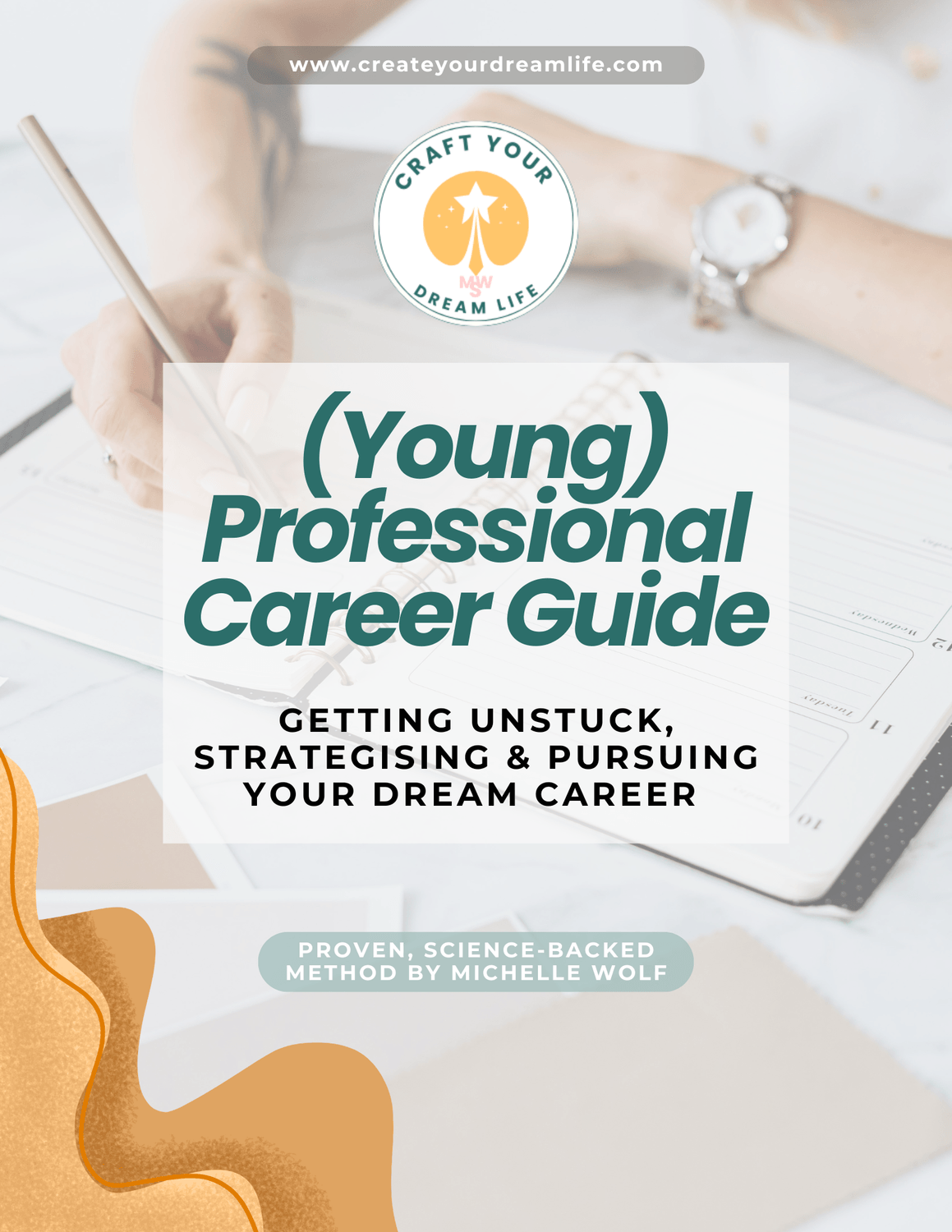
Take me to the (Young) Professional Career Guide
I would love to hear your thoughts!
Share your thoughts with me
michelle.wolf.business@gmx.de
Let's begin & craft your dream life!
©2025 by Michelle. All Rights Reserved.